CRM Enrichment as a Conversion Driver: Beyond Call Recording
CRM enrichment moves conversion when the fields come from the sales conversation, not a third-party database. Here is how recording becomes the next CRM update.

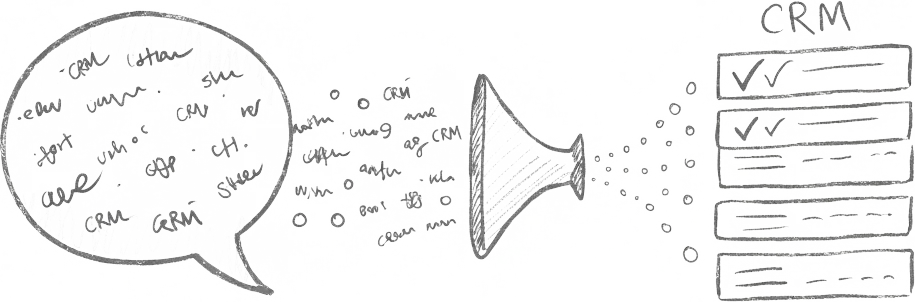
CRM enrichment drives the next action when the fields come from the sales conversation, not from a third-party database bolted onto the record. The data then reflects what the prospect actually said. Call recording alone does not do this. Recording captures the conversation. Enrichment writes the fields, flags deal risk, and gives the next rep the context the prospect already shared.
Most sales teams are living in the gap. Calls recorded, pipeline rotting, reps re-asking questions the prospect already answered.
The problem isn't recording. It's what happens after.
Most sales teams have solved the recording problem. Gong, Fathom, Chorus, Granola — pick your tool, the call gets captured. The problem is that the record and the CRM live in separate worlds. The call sits in a transcription library. The CRM stays empty, stale, or wrong.
Recording alone doesn't move the conversion needle. The rep had the conversation. The information exists. It just never reached the system that drives the next action.
What CRM enrichment actually means in 2026
Two kinds of CRM enrichment exist, and the distinction matters.
Third-party enrichment appends external data to a record: firmographics, technographics, job titles from Clearbit, ZoomInfo, Apollo. Useful at the top of the funnel. Useless mid-pipeline, because the prospect's budget, timeline, decision criteria, and objections aren't in any external database. They're in the call recording from last Tuesday.
Conversation-driven enrichment pulls fields from the calls themselves: budget mentioned on the discovery call, decision maker named on the demo, objection raised in the pricing conversation, timeline committed to in the follow-up. The value is the field the next rep can act on, because it reflects what the prospect actually said.
Call recording tools stop at the transcript. Conversation-driven enrichment turns the transcript into structured CRM fields, automatically, with the rep approving before anything syncs.
How Demodesk closes the gap between the call and the CRM
Demodesk is built on a simple premise: insights without execution are worthless. The AI CRM Concierge updates Salesforce, HubSpot, or Pipedrive after every call, with 99% accuracy and human-in-the-loop approval before push.
On a typical sales call:
- AI Assistant records the call (video, phone, in-person via the mobile app), transcribes it in 98 languages, and drafts a summary and follow-up email.
- AI CRM Concierge identifies the deal and contacts, extracts field updates from what was actually said (budget, timeline, pain points, next steps, competitors mentioned), and surfaces them for the rep to review in a chat preview.
- The rep edits anything that needs correcting, hits approve, and the CRM updates, including custom fields mapped to your sales methodology.
- AI Deal Insights flags risks based on what the prospect said (or didn't say): champion going quiet, pricing objection unaddressed, decision timeline slipping.
The result: a CRM that reflects reality, enriched from the conversation itself, with no rep spending 30 minutes after the call typing notes into fields.
A German media company's reps run up to 20 new business calls per week. Their CRM data quality was already 5/5 before Demodesk. The problem was keeping it that way at that volume.
"Sometimes our reps have 20 new business sales calls a week. It's impossible to remember what happened in all of those calls. Therefore, Demodesk helps in every single deal, since it's our only way to keep track of what happened during all those sales calls."
— Sales Operations, a German media company
A German sustainability software company moved CRM data quality from 2/5 to 3/5 within weeks of rollout, with reps saving 5+ hours per week on admin — time that went back into selling.
Why conversation-driven enrichment outperforms third-party enrichment on conversion
Third-party enrichment answers "who is this account?" Conversation-driven enrichment answers "where is this deal, and what does it need next?" The second question moves conversion rates.
Consider what external data can and can't tell you:
| What you need to know | Third-party enrichment | Conversation-driven enrichment |
|---|---|---|
| Company size, industry, tech stack | Yes | No (not its job) |
| Decision maker's title and LinkedIn | Yes | Yes (if named on call) |
| Budget range mentioned | No | Yes |
| Specific objections raised | No | Yes |
| Competitors evaluated | No | Yes |
| Timeline and next steps committed | No | Yes |
| Champion engagement signals | No | Yes |
| Current pain in prospect's own words | No | Yes |
Third-party enrichment is table stakes for prospecting. Conversation-driven enrichment turns a recorded call into a converted deal.
The compliance layer most tools skip
For European sales teams, enrichment from call content runs straight into DSGVO, works council, and DPO scrutiny. The call is personal data. The enriched CRM field derived from it is also personal data. If your enrichment tool stores recordings on US infrastructure, trains its models on your calls, or can't satisfy a works council review, the enrichment program dies in legal review.
Demodesk is built for this: ISO 27001:2022, EU-only data centers (Azure Frankfurt), configurable retention (12 hours to 1 year, with bookmarked recordings excluded from auto-deletion), works-council-compatible consent flows, and your data never trains the AI. The "delete by default, selectively retain for coaching" model is designed for the German works council review.
For 50-500 rep European teams, compliance is the gate the enrichment program has to pass through before it ever reaches the conversion math.
How to move from recording to enrichment in 30 days
Your team already records calls. The CRM is still half-empty. Here's the path:
Week 1: Pick 5-10 CRM fields that actually drive your pipeline forecast. Budget, timeline, decision maker, next steps, main objection, main competitor. Not 50 fields. The 5-10 that reps leave blank or fill in wrong today.
Week 2: Connect your conversation-recording tool to your CRM with AI-driven field extraction. In Demodesk, the AI CRM Concierge auto-detects deals and fields, and you map custom fields in a few minutes.
Week 3: Run human-in-the-loop for every call. The rep reviews suggested field updates before they sync. This builds trust fast and catches edge cases where the AI misreads context.
Week 4: Measure the delta. Pipeline hygiene, forecast accuracy, time-to-first-touch on new leads, and conversion from stage to stage. The number Demodesk publishes for the admin itself is about 30 minutes saved per call.
By day 30 the CRM reflects what's actually in your pipeline, reps aren't typing field updates after calls, and the conversion math starts moving.
That write-back is what an AI sales agent is for: the conversation becomes the CRM update.