Field Sales Mobile Recording: A Different Use Case Than Inside Sales
Field sales mobile recording solves a different problem than inside sales recording: offline capture, in-person consent, and CRM updates from the car — not the desk.

Field sales mobile recording is not inside sales recording on a smaller screen. The channel is different (in-person, not Zoom), the device is different (phone in a jacket pocket, not a laptop), the environment is different (customer site, parking lot, warehouse floor), and the consent model is different (verbal, in the room, not a disclaimer banner in a video window). Treating the two as the same use case is why most “mobile sales” rollouts stall: inside-sales tools get bolted onto field reps, adoption collapses, and the pipeline keeps running on memory.
This post walks through what makes field sales recording a distinct problem, what to look for in a tool, and how we built the Demodesk mobile app around it.
Why field sales recording is a different use case
Inside sales recording solves one problem well: the rep is already at a desk, on a video call, with a notetaker bot sitting silently in the meeting. Transcription happens in the cloud, summaries appear in the CRM, and the rep moves to the next call. The whole workflow assumes a stable internet connection, a scheduled calendar event, and a known participant list.
Field sales breaks every one of those assumptions.
- No scheduled meeting to join. A field rep walks into a dealership, a construction site, or a hospital. There is no calendar invite, no Zoom link, no bot to dispatch. The “meeting” starts when the handshake does.
- No reliable connectivity. Reps drive between accounts, work from basements and job sites, and lose signal constantly. Any recording tool that requires a live upload will drop conversations.
- The device is a phone, not a laptop. Opening a laptop in a customer meeting signals that the rep is about to type instead of listen. A phone resting on a table does not.
- Consent happens out loud, not in a popup. You cannot show a GDPR banner to the person sitting across from you. Consent is verbal, in the room, and has to be captured as part of the record.
- The admin window is a 15-minute drive, not 15 seconds between calls. Inside reps update the CRM between back-to-back Zooms. Field reps update it (if at all) at the end of the day, from memory, often across 4–6 visits. Salesforce’s State of Sales research finds reps spend roughly 40% of their week selling — the other 60% is admin, driving, and internal meetings. For field reps, the driving part is non-trivial, and the admin almost always loses.
The result, as summarized by LeadBeam: “Follow-ups slip because they were never recorded. Forecasts get built on roughly 15 percent of actual activity.” That is the field sales problem in two sentences. It is not an inside sales problem with a mobile skin.
What field sales mobile recording actually needs
Compare what field reps need against what a standard inside sales recorder provides, and the gaps are specific and consistent.
| Capability | Inside sales recording | Field sales recording |
|---|---|---|
| Trigger | Bot joins scheduled video call | Rep taps “record” on phone before walking in |
| Connectivity | Live cloud upload during the call | Offline capture, upload when signal returns |
| Device | Laptop + Zoom/Meet/Teams | Phone (iOS/Android), sometimes CarPlay |
| Consent | Disclosure banner, meeting notification | Verbal consent captured inside the recording itself |
| Transcription | Multi-speaker, clean audio, fixed mic positions | Variable audio, background noise, multiple speakers, possibly non-English |
| Follow-up admin | CRM update from the desk, same day | CRM update between visits, often from the car |
| Report format | Call summary, deal updates | Site visit report, next steps, photos of the location/product |
A tool built for inside sales will technically “work” on a phone — most of them have an app. But the workflow it enforces (schedule meeting, bot joins, review from laptop) does not match how a field rep’s day runs. Reps either stop using it, use it only for their occasional video calls, or fake-adopt it to keep the manager quiet.
The non-negotiables for field
Based on how our field-selling customers (and our own field reps) use the mobile app, five things matter:
- One-tap start, from the lock screen. If it takes more than 2 seconds to start recording, the rep will not do it when a customer walks up unexpectedly.
- Offline capture. The recording stores on-device and uploads when there’s signal. No “we’ll try again later” errors.
- In-person consent built into the flow. The rep plays or reads a short disclosure before the conversation starts; that disclosure is part of the recording. This is what satisfies DPOs and works councils for in-person capture.
- After-visit site report, not just a call summary. Field reps need what was discussed, what was promised, what the next step is, and which deal it belongs to — formatted for a site visit, not a sales demo.
- CRM update from the phone, before the next visit. Reviewing a 40-minute transcript on an iPhone screen is a bad experience. Approving a pre-filled CRM update in 30 seconds is a good one.
Any one of these missing, and the pipeline-visibility problem comes right back.
How Demodesk handles field sales recording
Demodesk is built as the conversation layer across every channel a sales team uses: video calls, phone, dialer, in-person, and field. The mobile app is the field-sales entry point.
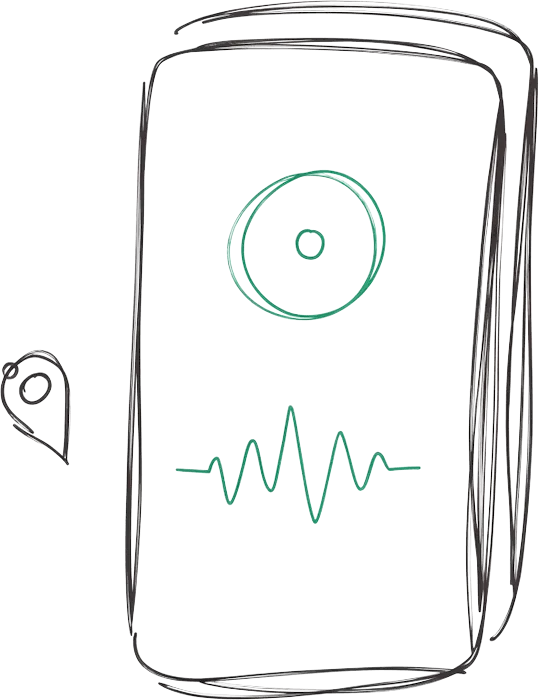
What the rep does: Opens the Demodesk app before a customer visit, taps record, states the consent line (or plays it from the app), and puts the phone on the table. After the meeting, the app transcribes the conversation in 98 languages, generates an after-meeting site report, and drafts the CRM update. The rep reviews the update on the phone — not a 40-minute transcript, just the fields that changed and the suggested next steps — and taps approve. The CRM is current before they pull out of the parking lot.
What the manager gets: The same company-wide conversation record that covers inside sales calls, phone dialer calls, and video meetings. One search, one coaching queue, one source of truth for what customers said — regardless of whether the conversation happened on Zoom, on the dialer, or in a dealership in Stuttgart.
The agents that act on inside-sales recordings act on field recordings too:
- AI Assistant generates the site visit report and drafts the follow-up email.
- AI CRM Concierge proposes the field updates on the right deal, with human-in-the-loop approval before anything syncs.
- AI Coach scores the field conversation against your scorecard (MEDDIC, BANT, or a custom field-sales methodology) so coaching covers field reps, not just inside reps.
- AI Deal Insights flags risk based on what was said — including things reps often forget to log, like “the budget holder isn’t the person we met with.”
Everything runs on EU-hosted infrastructure (Azure Frankfurt), stored under configurable retention policies that satisfy German works councils, and ISO 27001:2022 certified. No transatlantic data transfers. Your conversations stay in the EU.
Pricing is the same as the rest of the platform: EUR 25/user/month on the Capture tier (recording + AI Assistant + CRM sync) or EUR 49/user/month on Coaching & AI (adds AI Coach, AI CRM Concierge, AI Deal Insights, AI Analyst). Free viewer seats for managers and ops. No separate “mobile add-on.”
The organizational benefit: one record across inside and field
Most sales orgs end up with two recording tools — one for inside, one for field — because nobody built a product that treats both channels as equal citizens. Inside sales buys Gong or Fathom, field sales buys something like Voiceline or a dedicated field CRM, and the two never talk to each other. Deals that move between channels (field rep gets the meeting, inside rep closes the renewal) lose their conversation history at the handoff.
Recording everything on one platform is not about operational tidiness. Your AI stack — whether that’s Demodesk’s agents, your own Claude workflows, or a Snowflake query — can only act on the full picture if the full picture exists. As the Field Sales Software Market grows (projected to reach USD 8.62 billion by 2031 at 12.19% CAGR), the gap between teams running on fragmented conversation data and teams running on a unified record will widen. Mobile CRM usage is already correlated with a 26.4% productivity lift for sales reps — but only if the conversations are captured in the first place.
Field recording is not a feature. It is a channel. If your conversation layer doesn’t cover it, you’re forecasting on 15% of what’s happening.