Multi-Agent Orchestration in Sales: From Calls to Action
Multi-agent orchestration turns unstructured sales conversations into CRM updates, coaching, and deal rescue — automatically. Here's how it actually works.

What is multi-agent orchestration in sales?
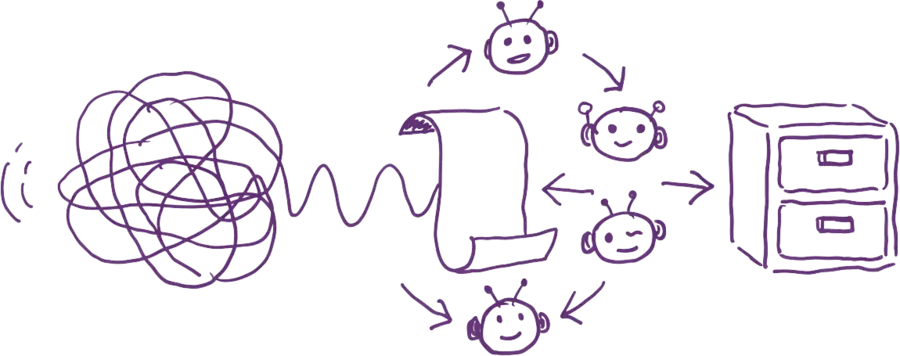
Multi-agent orchestration in sales is an architecture where specialized AI agents — one for capture, one for coaching, one for CRM updates, one for deal risk — each run on the same conversation record and hand off to each other without a human in the middle. The rep talks to a customer. Within seconds, the record is captured, a scorecard is written, CRM fields are drafted, and risks are flagged. The rep approves. Nothing else gets touched.
Instead of one monolithic "sales AI" trying to do everything badly, you run several narrow agents that each do one thing well, sharing a single conversation record. The result is 45% faster resolution and 60% more accurate outcomes than single-agent systems, according to enterprise benchmark data. For sales teams specifically, Fullcast's 2026 data shows teams deploying coordinated AI agents report 81% revenue growth.
Your sales data is 90% unstructured. Your CRM is 100% structured.
Every sales conversation produces a few megabytes of unstructured data: the spoken call, the objections, the champion's hesitation, the budget hint dropped at minute 32. Your CRM expects a dropdown, a date field, and a stage.
The gap between the two is where pipelines rot.
For a decade, the industry's answer was to make reps do the translation: listen to your own call, remember what mattered, type it into Salesforce. Reps hated it. Managers couldn't inspect it. 73% of sales managers spend less than 5% of their time coaching because they're buried in the same translation problem one level up.
Conversation intelligence tools — Gong, Chorus, Modjo — closed part of the gap. They captured the conversation and made it searchable. But they still assumed a human would do the acting. CI told you what happened on the call. It didn't do anything about it.
Multi-agent orchestration closes the rest. The conversation is captured once. Specialized agents act on it in parallel. The rep reviews, approves, and moves on.
How multi-agent orchestration actually works
The architecture has three layers. If you've read our GTM AI Readiness framework, this is what L3 and L4 look like in practice.
Layer 1: One record, every channel
Before any agent can act, you need a single, permissioned record of every customer conversation — video calls, phone calls, in-person meetings, field visits. Not one record per tool. One record, period.
This is the foundation. Without it, each agent works from partial data and the handoffs break.
Layer 2: Specialized agents, each with one job
Specialized agents consistently outperform monolithic ones. Each agent is deeply optimized for its function while sharing context with the others.
At Demodesk, this maps to four production agents:
| Agent | What it does | Trigger |
|---|---|---|
| AI Assistant | Captures, transcribes, summarizes, drafts the follow-up email | On call end |
| AI Coach | Scores the call against MEDDIC, BANT, Challenger, SPIN, or your custom scorecard | On transcript ready |
| AI CRM Concierge | Detects which deal the call belongs to, drafts field updates, waits for rep approval before pushing | On transcript + scorecard ready |
| AI Deal Insights | Scans the record for risk signals — champion going quiet, budget objections, competitive mentions — and alerts the owner | Continuous, across all calls on a deal |
Each agent is narrow. Each is predictable. Each writes back to the same record, giving the next agent in the chain richer context than the last.
Layer 3: The orchestration layer (portable, not locked in)
The handoffs between agents — and between Demodesk and whatever else you run — happen through an open platform: an MCP server, a REST API, and a SQL API on the record itself.
Sales teams don't run one AI. They run Claude for research, Copilot for email, Salesforce Einstein for forecasting, and five internal agents built on top of OpenAI. If your conversation data is locked inside one vendor's walled garden, every downstream agent works blind.
Portability is the point. The conversation record stays yours, queryable by any agent you choose to point at it.
What this looks like in a sales team's week
Take a 15-rep mid-market team running Salesforce, each rep averaging 8 calls a day. That's 120 conversations a day, 600 a week.
Without orchestration, reps spend about 30 minutes per call on post-call admin: notes, CRM updates, follow-up emails. That's 4 hours a day of selling time lost per rep. The manager coaches 3-4 calls a week per rep if they're disciplined. Pipeline reviews happen on Friday, based on whatever reps remembered to log.
With multi-agent orchestration:
- AI Assistant drafts the summary and follow-up in the 60 seconds after the call. Rep edits, sends.
- AI Coach scores the call against the team's MEDDIC scorecard. The rep sees their own card immediately. The manager sees the three calls in the week worth reviewing.
- AI CRM Concierge detects the deal, drafts 6-8 field updates, asks the rep to approve. Rep clicks once. CRM is current.
- AI Deal Insights notices the champion hasn't been on the last two calls. Alerts the owner before the deal slips.
The rep gets about 2 hours a day back. The manager coaches 1:50 instead of 1:10. The CRM runs at 99% accuracy instead of 60%. That's the orchestration dividend.
A German software review platform with reps running 20 new-business calls a week each put it this way: "It's impossible to remember what happened in all of those calls. Demodesk helps in every single deal, since it's our only way to keep track of what happened during all those sales calls."
Why specialization beats one big agent
The temptation, with frontier LLMs, is to build one giant agent that does everything. It doesn't work, for three reasons.
Context collapse. A single prompt that handles capture, coaching, CRM updates, and risk detection does none of them well. Specialized agents keep their prompts tight.
Trust, piece by piece. Reps won't approve a black box that scores their call, updates their CRM, and drafts their email in one pass. They'll approve each piece separately. Multi-agent architectures match how humans actually grant trust.
Observability. When something goes wrong — a wrong CRM field, a bad coaching score — you need to know which agent made the call. Monolithic agents are unobservable. Specialized agents are debuggable.
This is why Fullcast and others report 7-25% revenue increases and up to 70% productivity gains from multi-agent sales systems: specialization scales, monoliths don't.
How Demodesk implements this
Demodesk is built as a multi-agent system by design, not retrofitted from a single-agent product.
Capture is the foundation. Every channel — video, phone, dialer, in-person, field — produces the same permissioned record. Agents never work from partial data.
Four specialized agents ship in the box. AI Assistant, AI Coach, AI CRM Concierge, AI Deal Insights. Each fine-tuned on 10M+ real sales conversations.
Orchestration is open. MCP server, REST API, SQL API, and AI Crew for building your own agents. Point Claude, Copilot, or your internal LLM at the record.
Human-in-the-loop by default. CRM Concierge drafts; the rep approves. Coach scores; the rep sees first. Nothing acts on the customer's behalf without rep consent.
EU-native trust. ISO 27001:2022, GDPR, Frankfurt hosting. Your data never trains our AI. Works-council-compatible consent flows.
Capture starts at €25/user/month (annual). The full multi-agent stack — Coaching & AI — is €49. The open platform is included with every plan; you pay only for the AI compute you use.
Where teams get orchestration wrong
Three failure modes we see when teams try to roll their own.
Building agents before fixing capture. If your record is Zoom-only but your reps also sell on the phone and in person, 40% of your conversations are invisible. No agent can act on data it doesn't have. Fix capture first.
Skipping the approval layer. Teams excited about automation turn off the human-in-the-loop and let agents push directly to CRM. Accuracy drops. Trust evaporates. Adoption collapses. Keep the rep in the loop until the agent earns the right not to be.
Locking data into one vendor. If your conversation record only works inside one vendor's UI, you've traded a CRM silo for an AI silo. Pick infrastructure with an open API from day one.